Laptop (ODM Project)
Duration: 7 Months
Process: RFQ to Mass production
Brand: HP
Work at: Wistron
In this project, my responsibility entails transforming a conceptual 3D Master from HP into a design ready for mass production. This process involves 3D modeling, refining the design with cross-functional teams, creating prototypes, reviewing Design for Manufacturing (DFM), overseeing Color, Material, and Finish (CMF), and ensuring quality control during the NPI process. Additionally, I'm also involved in the packaging design, including material try-outs, packaging layouts, and reliability testing


A design without any straight curves
The 2023 Envy 14 x360 presents a unique design challenge: it features complex, continuous curvature withouta single straight edge. This intricate geometry not only complicates the CAD modeling process but also intro duces significant hurdles down the line in manufacturing—specifically during metal stamping, polishing, fixture creation, and CPK measurement for quality control.


Design and Engineering
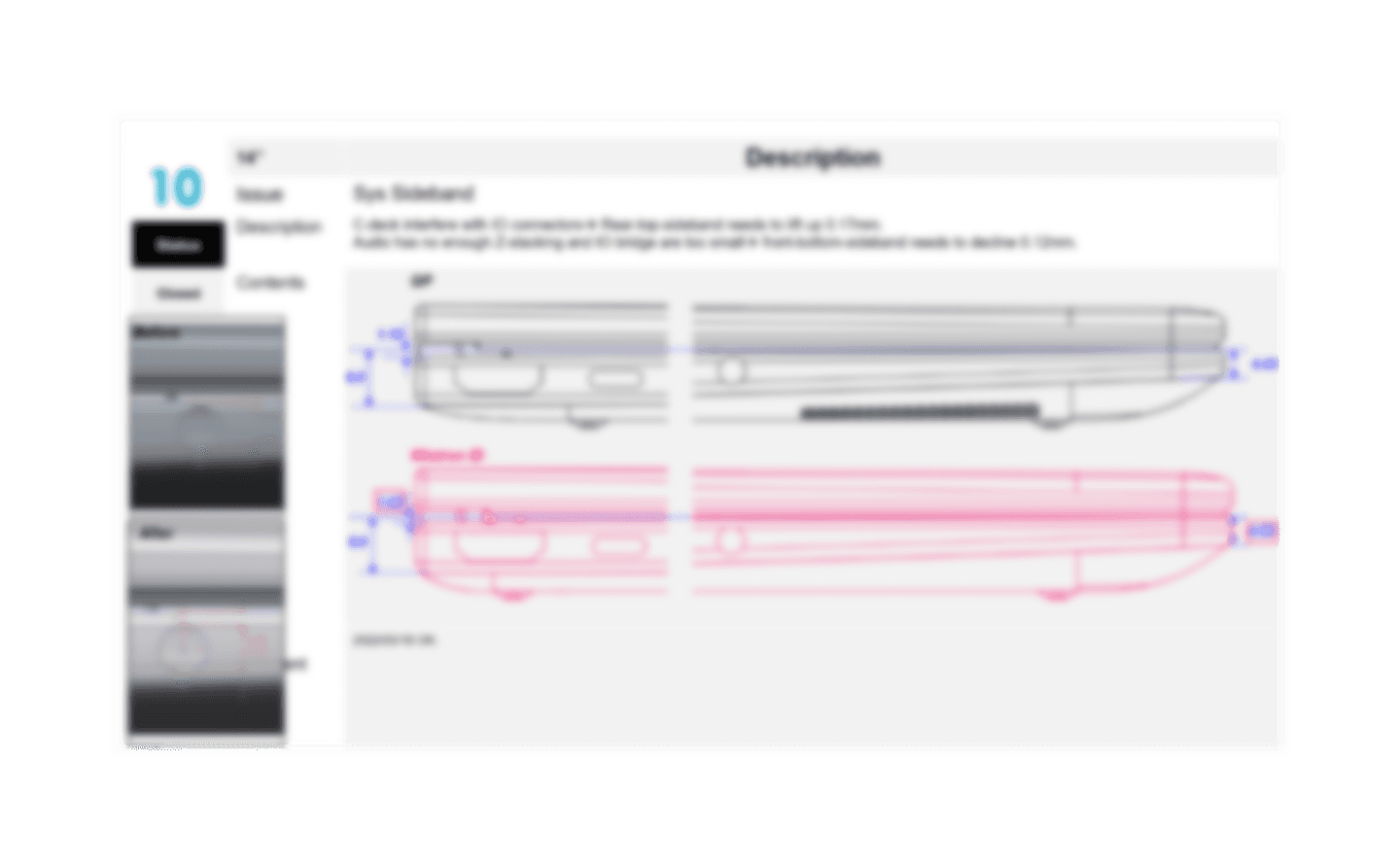
Laptop engineering is among the most complex domains in consumer electronics. As an ODM industrial designer, I must drive cross-functional alignment across ID, ME, EE, RF and Thermal teams, while managing vendor collaboration and assembly line communication. All within highly compressed development timelines.




CMF Execution
Laptops are constructed by many complex parts. Given HP’s reputation for exceptionally high cosmetic quality standards, my core responsibility is to execute CMF reviews, track vendor progress, and drive cross-functional communication to get final approval from the HP CMF team.

Major cosmetic quality challenge - KB Dish Stamping
The two ends of the keyboard dish feature a sharp line that necessitates a subtle fade effect at the edges. Achieving this effect demands exceptionally precise stamping and polishing techniques. Any deviation could result in defects such as twisted lines, over-stamping, or uneven transitions between the two sides. Specifically for the keyboard dish, we made over 20 modifications to the stamping die to ensure perfection.

Major cosmetic quality challenge - Polishing
After the aluminum is stamped, it undergoes several subsequent processes to become the final assembly-ready part. One of the most challenging processes is polishing, given that the housing design lacks straight lines and consists entirely of curved surfaces. Achieving a consistent curvature surface without any sharp edges requires numerous adjustments to the parameters of the ABB polishing machine.

Packaging Quality Control
Even though Wistron has a dedicated engineer for the project, HP ID also oversees the product unboxing experience. Because of this, I was responsible for reviewing the packaging quality and act as the bridge to gather feedback from the HP ID team.

Parametric control for user experience
During the proto-build stage, we reviewed both cosmetic quality and the overall user experience. This included testing one-hand lifting, camera shutter door force, and acoustic inspections to check for any rattling. During our review, we found that the shutter door was difficult to slide. To optimize the user experience, we collaborated with mechanical engineers to resolve the issue and established parametric controls to keep the sliding force within specification.

Product Gallery


Wisarut Aroonkayan │ Yuh Shyan Lin
Email: Wisteinlin@gmail.com
Cel: +886 953-663-906
©2026 Wisarut Lin. All right reserved.